
WhatsApp Chatbot vs Booking System: What Home-Service Companies Actually Need

Almost every week we hear the same story from a cleaning or maintenance company owner: "We installed a WhatsApp chatbot. Customers ask questions and it just rambles." The problem is not the idea, the idea is excellent. The problem is that not every bot is built the same. This article breaks down the difference between a generic WhatsApp chatbot for business and a WhatsApp booking system built specifically for home-service companies, and why that difference shows up directly in your booking calendar, not just in how the chat feels.
What does a generic bot actually do?
Generic bots, often marketed as an "AI receptionist", work roughly the same way everywhere: a friendly greeting, answers to common questions, and at the end they collect the customer's name and number and promise that "our team will contact you shortly".
For some businesses that is enough. A restaurant answering "what time do you open?" needs nothing more. But a cleaning, pest-control or AC-maintenance company? Your conversation is not small talk, it is the sale itself: how much, when can you come, and do you even cover my neighborhood. A bot that cannot answer those three questions has very little left to offer.
Three gaps every generic bot falls into
1. Pricing: "the team will contact you" is not a price
The customer asked: "How much for a three-bedroom apartment in Riyadh?" A generic bot has two options: invent an answer from the model's imagination (a disaster if it quotes wrong), or reply "our sales team will contact you". Both mean the same thing to the customer: waiting. And a customer who waits opens the next chat and books with your competitor.
A specialized system is connected to your actual service list and price book. A three-bedroom apartment has a price, a villa has another, deep cleaning differs from regular. The answer comes instantly and comes from your data, not from an AI guess.
2. Scheduling: the bot cannot see your technicians' calendar
This is the biggest gap. Most generic bots have no connection to your schedule at all. The best they can do is record "customer wants tomorrow afternoon" somewhere, and then your staff calls to confirm. Which puts you back at square one: phone calls, manual confirmations, and double bookings.
A real WhatsApp booking system reads the calendar live: it knows team A is busy at noon and team B finishes a job in Al Nargis at three, so it offers slots that are actually available. The customer picks one and the booking is confirmed inside the same conversation. No phone call involved.
3. Location: the customer's district matters, and the bot has no idea
In home services, geography is half of scheduling. A 4pm slot in north Riyadh is useless if the previous job ends at 3:30 on the other side of the city. A generic bot does not even know what a "district" means, so it happily books appointments no technician can reach, which ends in cancellations and angry customers.
Specialized systems calculate drive time between jobs before showing a slot. If your team cannot make it, the slot simply never appears. Simple, but it is the difference between an organized day and chaos.
Want to see the difference yourself? Try the live WhatsApp demo and watch it quote and book in one conversation, or start free and set up your own in a day.
Fine, but what about dispatch software?
On the other side of the market sit the big field-service dispatch platforms. These are the exact opposite of a generic bot: very strong at scheduling and dispatching, weak at conversation. They are built for a dispatcher sitting at a big screen, not for a customer booking from their phone.
In the Saudi market they carry extra baggage too: most are English-first with token Arabic translation, priced in dollars for American contractor businesses, and above all they expect the customer to open a link and fill a form. Customers here do not do that. Customers here type "I need cleaning tomorrow" into WhatsApp and expect an answer. If your system does not meet the customer inside WhatsApp, you are asking them to learn a new habit just to pay you money. That rarely goes well.
The formula that works: conversation + live calendar + map
The answer is not "a smarter bot" or "a bigger scheduler". The answer is all three working as one piece:
A natural Arabic conversation that understands dialect, replies in the customer's own style, and hands over to a human whenever asked. A live calendar that knows every technician's day and books directly with no manual step. And a geographic layer that guarantees every slot shown is a slot your team can physically reach.
When those three come together, the "how much for apartment cleaning?" message that lands at 11pm becomes a confirmed booking at 11:03pm. We wrote earlier about WhatsApp auto-replies for after-hours customers and about booking software for cleaning companies; this article completes the picture. Replying without booking is half a solution, and booking without conversation is a solution nobody reaches.
How to choose: five questions to ask before you subscribe
First: does the bot quote a real price from my price list, or does it say "we will contact you"? Second: does it see my technicians' calendar live and book on its own? Third: does it account for distance between jobs, or does it book blind? Fourth: is Arabic a first-class language or a translation? Write to it in dialect and see. Fifth: when a customer asks for a human, is the handover smooth or does the customer get stuck with the bot?
Any "no" out of those five means you will pay a subscription and still do the work manually.
FAQ
Can I connect a generic bot to a separate scheduling tool?
In theory yes, through integration tools. In practice you need a developer, and every update on either side can break the connection. And when a customer's appointment goes wrong, there is nobody to blame but yourself. A unified system takes that whole burden away.
I run a small company with two crews. Do I really need this?
Small companies benefit the most. You have no call-center staff covering messages, so every lost late-night message is a lost booking. The system works like a receptionist who never sleeps.
Will customers know they are talking to an AI?
Transparency is better, and the system can introduce itself. The irony is that most customers do not care. What they care about is getting a price and an appointment in two minutes instead of waiting until morning.
What happens with unusual requests that have no fixed price?
A specialized system knows its limits: it collects the details and passes them to your team as a quote request instead of inventing a number. That is exactly the difference from a generic bot that answers everything confidently, even when wrong.
Try the difference yourself in two minutes. Message the live WhatsApp demo, ask for a price and a slot, and see what a system built for your trade feels like. Or start free with GeoWise today.
Related Articles
Managing Seasonal Demand Peaks in a Service Business: Surviving the Gulf Summer Without Adding Hours
The Gulf summer peak is predictable, not a surprise. The real constraint is not technician hours, it is drive time between jobs and the enquiries nobody answered while everyone was on site.
The After-Hours Problem: Why Home-Service Enquiries Go Cold Overnight in the Gulf
Most home-service enquiries in the Gulf arrive outside working hours, and half go to whoever replies first. What the silence costs, why a night shift is the wrong fix, and the five things an always-on WhatsApp agent has to get right.
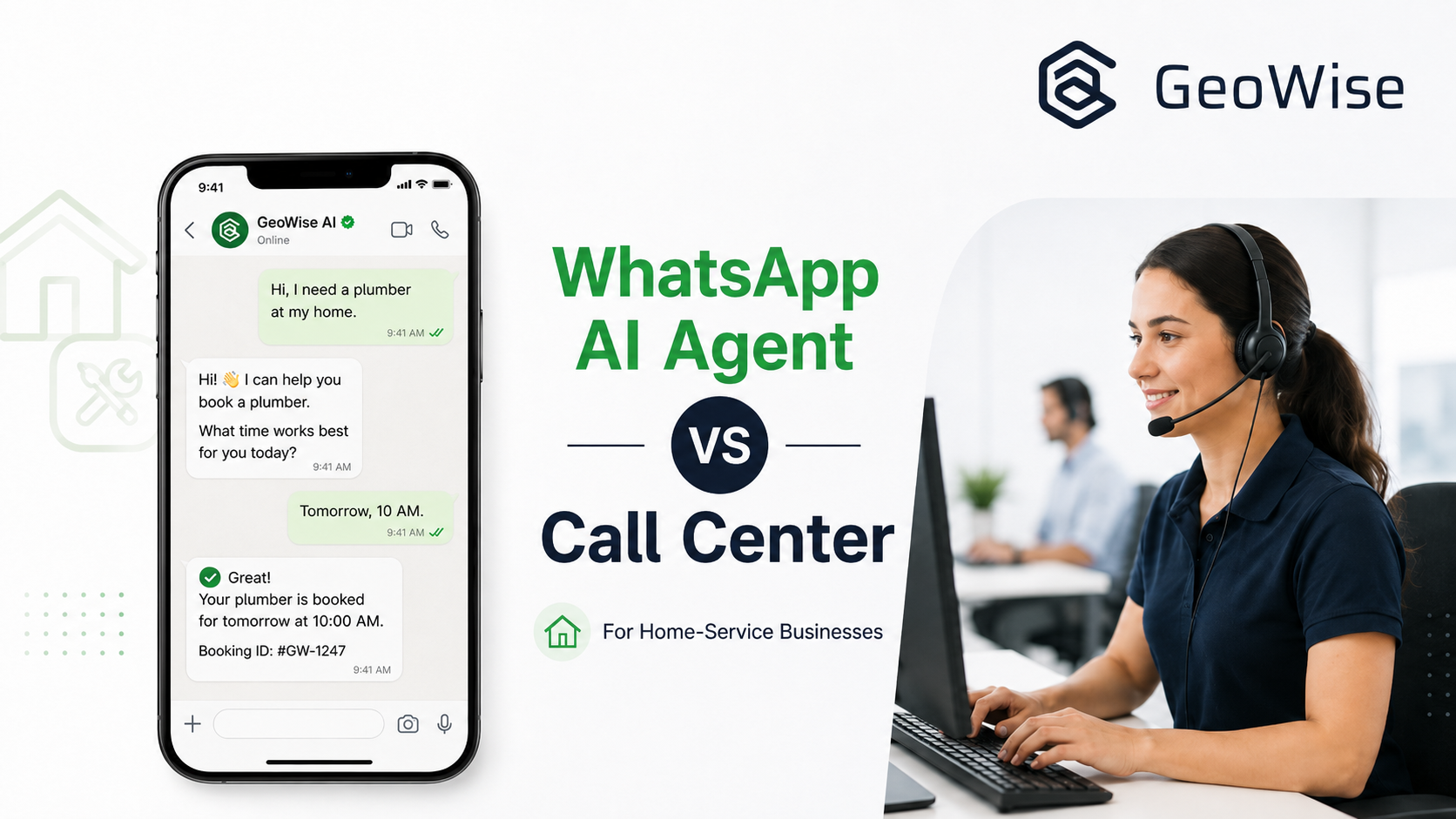
WhatsApp AI Agent or Call Center? Choosing for a Home-Service Business
Ditch traditional call centers for a WhatsApp AI agent to boost response speed and scalability in your home-service business