
Field Service Scheduling Software: Why Global Dispatch Tools Struggle in Saudi

Walk into the office of almost any cleaning or maintenance company in Saudi Arabia and you will find the same setup: a WhatsApp number overflowing with requests, an Excel sheet with technician schedules, and a whiteboard with today's jobs. If the company is a bit more "advanced", there is also a subscription to some expensive foreign platform that exactly one employee half-uses.
This article is about field service scheduling software: what it is actually supposed to do for you, why the big global dispatch tools keep failing home-service companies here, and what a system built around how we really work looks like.
What does field service scheduling software actually do?
In plain terms, it decides who from your team goes to which customer, when, and in what order. A request comes in, the system checks who is free, who is nearby and who has the right skills, then drops the job into their schedule. The technician sees his day on his phone, the office sees everything on one screen.
The theory is lovely. The problem is that most of the software doing this was designed for a different market, and that is where the pain starts.
Why global dispatch tools struggle in Saudi Arabia
1. Your customer books on WhatsApp, not on an app
Global platforms assume the customer visits your website, fills a form and picks a slot from a calendar. Saudi customers do not do that. They open WhatsApp and type: "Salam, how much for a two-bedroom apartment in Al Yasmin?" If your scheduling system cannot take the booking inside WhatsApp itself, you have a gap: an employee copying customer messages into the system by hand. Every manual step means errors, delays, and customers who give up waiting.
2. Our addresses are not tidy street numbers
American software expects "123 Main Street". Your customer sends a Google Maps pin, or writes "Al Narjis district, behind the school". A scheduler that does not understand districts and real drive distances will assign jobs blindly: one technician crossing the whole city between two appointments while another sits idle in the same neighbourhood. Fuel and hours burn on trips that never needed to happen.
3. Your team will not use a system it cannot read
An English-only interface means half your team quietly ignores the system and goes back to WhatsApp and phone calls. Two months later you discover you are paying a monthly subscription for software nobody opens. Honestly, this is the single most common story we hear from owners who tried the big-name tools.
4. You pay for things you do not need
Enterprise field service platforms are priced in dollars per user and packed with features built for companies running 50 technicians and a full dispatch department. A cleaning company with 8 technicians needs something else entirely: a system that answers the customer, quotes, books and assigns intelligently. No implementation consultant, no three-week training program.
Want to see the difference instead of reading about it? Try the live WhatsApp demo and watch a request turn into a scheduled booking in under a minute, or start free and test it on your real workload.
Good scheduling starts from the customer's location, not the calendar
The real line between basic scheduling and smart scheduling is one question: does the system calculate drive time?
When a customer in Al Malqa asks for a 4pm slot, a smart system does not just ask "who is free at 4?" It asks: who will already be near Al Malqa around then? How long is the drive from their previous job? Can they still make the one after? The slots shown to the customer are built on that math from the start, so impossible bookings simply never get made.
The practical result: fewer kilometres between jobs, one or two extra jobs per technician per day, and a less exhausted team. That is not a luxury feature. That is direct profit at the end of the month.
A checklist before you subscribe to anything
Does booking happen inside WhatsApp itself? Not a link that kicks the customer out to a website. The whole thing, from first question to confirmation, inside the chat. We wrote before about why WhatsApp is the right place to start if you want the full argument.
Does it reply instantly after hours? Half of your requests arrive at night. A system that sleeps when your staff sleeps is losing you half your potential customers.
Does assignment account for distance and drive time? If not, you will pay the difference yourself in fuel and dead hours.
Is it genuinely Arabic? The technician's interface, the customer messages, everything. Not Google Translate glued on top of an English product.
Does it know the difference between a chatbot and a booking system? There is a big one, and we broke it down in WhatsApp chatbot vs booking system.
FAQ
What is the best technician scheduling software for a small cleaning company?
For a small or mid-size company in Saudi Arabia, the best option combines three things: automatic booking intake from WhatsApp, smart assignment that understands locations and drive time, and a truly Arabic interface your team gets on day one. The huge global platforms are usually bigger and pricier than what you actually need.
Do I still need a dispatcher if I have smart scheduling?
Usually no. A smart system assigns jobs automatically based on location, skill and availability, and the office only supervises and handles exceptions. For small companies that is often a full salary saved.
How does the system handle reschedules and cancellations?
The customer changes the appointment from the same WhatsApp chat, and the system reshuffles the technician's day automatically, suggesting alternatives that do not break the rest of the schedule. No phone calls, no "let me check and get back to you".
How long does setup take from zero?
With systems built for this market, setup takes days, not weeks: enter your services, prices, coverage zones and team, connect your WhatsApp number, and you are taking bookings. No IT team, no technical consultant.
Bottom line
The right field service scheduling software is not the one with the most features. It is the one that works the way your customer and your team naturally work: the customer books on WhatsApp in Arabic, the system assigns with real knowledge of our cities and roads, and the team sees their day in their own language. Anything else turns into an abandoned monthly subscription.
Start where your customer already is: talk to the live WhatsApp demo and experience the booking flow yourself, or sign up free and be running within days.
Related Articles
Managing Seasonal Demand Peaks in a Service Business: Surviving the Gulf Summer Without Adding Hours
The Gulf summer peak is predictable, not a surprise. The real constraint is not technician hours, it is drive time between jobs and the enquiries nobody answered while everyone was on site.
The After-Hours Problem: Why Home-Service Enquiries Go Cold Overnight in the Gulf
Most home-service enquiries in the Gulf arrive outside working hours, and half go to whoever replies first. What the silence costs, why a night shift is the wrong fix, and the five things an always-on WhatsApp agent has to get right.
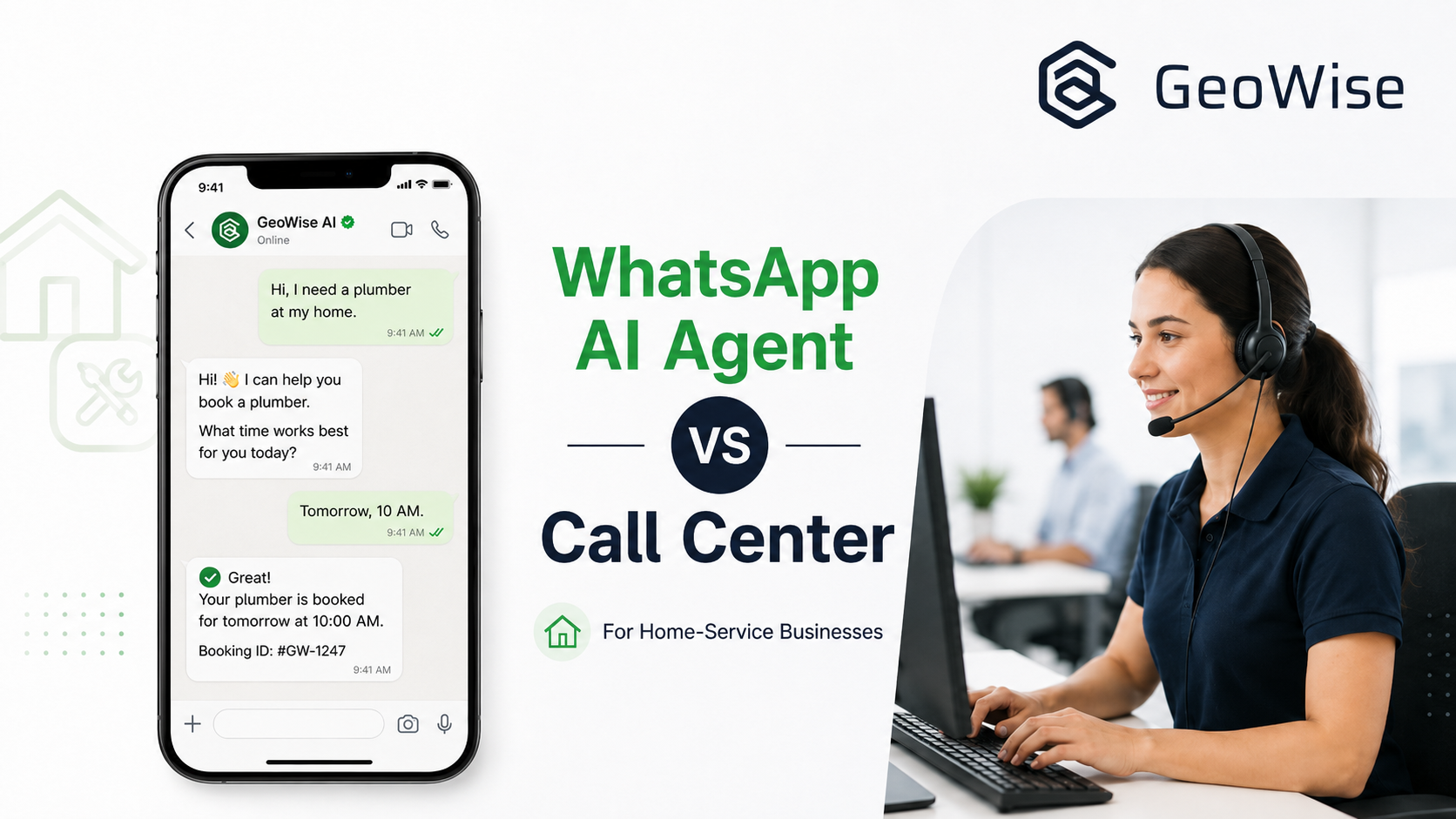
WhatsApp AI Agent or Call Center? Choosing for a Home-Service Business
Ditch traditional call centers for a WhatsApp AI agent to boost response speed and scalability in your home-service business