
WhatsApp Booking System for Cleaning Companies: Why It Beats Generic Schedulers

If you run a cleaning company in Riyadh, Jeddah or Dammam, you already know where your customers are: not on your website, not on a booking app — on WhatsApp. "How much for a 3-bedroom apartment?" arrives at 11pm. "Can you come tomorrow morning?" lands on Friday. And someone on your team is expected to answer all of it, check a spreadsheet, and reply before the customer messages your competitor.
The problem is not WhatsApp — WhatsApp is your best sales channel. The problem is running it manually. In this guide we break down what a WhatsApp booking system for cleaning companies should actually do, why generic schedulers and generic AI receptionists both fall short, and how to evaluate your options.
What manual WhatsApp handling really costs
A mid-sized cleaning company receives 30–50 WhatsApp conversations a day. If just 10% arrive after hours and wait until morning for a reply, that is 3–5 lost leads daily — and a customer who wants a cleaning typically messages three companies and books with whoever answers first.
- Double bookings and dead miles: two crews booked for the same slot, or one crew crossing the city between back-to-back jobs.
- No-shows: a customer books, forgets, and nobody reminded them — a full crew slot gone with zero revenue.
- Staff time: hours every day spent copy-pasting the same answers about prices, zones and availability.
None of these are minor "organisation" issues. They are revenue leaking out daily.
Why the usual tools fall short
Generic field-service schedulers
Global dispatch and scheduling software is excellent at calendars and invoices, but it assumes customers book through a website or an app. In the Saudi market that assumption is wrong: nobody downloads an app for a monthly cleaning — they are already inside WhatsApp. You end up with a great calendar and an employee still copying booking details out of chats by hand.
Generic AI receptionists
The other extreme is a general-purpose AI auto-responder. It replies politely, but it does not know your schedule: it cannot see that your east-Riyadh crew is fully booked on Tuesday or that sofa cleaning takes two hours, not one. So it chats — then hands the customer to a human to actually book. Back to square one.
The right answer: auto-reply + scheduling in one system
A real WhatsApp booking system combines both: an AI that understands the request in Arabic (dialect included), quotes the service, checks the live crew calendar, and confirms the appointment — all inside the same chat, with no human in the loop. That is exactly what we built GeoWise to do for home-service companies in the GCC.
See it yourself: message the live demo and watch the AI take a full booking inside WhatsApp — start your free trial.
6 criteria for choosing a WhatsApp booking system
1. Does it actually book inside WhatsApp?
Not a "WhatsApp button" that opens a chat a human answers. The bar: customer writes the request, the system quotes, offers slots and confirms — first message to last, unattended.
2. Does it understand Arabic and dialect?
Your customer writes colloquially, not in textbook Arabic. Test any system with real customer messages before you commit.
3. Is scheduling zone-aware?
The biggest hidden cost in cleaning operations is geography-blind dispatch. The right system clusters bookings by zone and cuts drive time between jobs.
4. Does it support dynamic pricing?
A two-bedroom flat is not a two-storey villa, and a same-day slot can price differently from next week. Flat pricing means manual intervention on every other booking — see our guide to dynamic pricing and duration without manual quotes.
5. Does it send reminders automatically?
A reminder the day before and two hours before the visit measurably cuts no-shows — and it arrives in WhatsApp, the one app your customer actually opens.
6. Does it handle recurring bookings?
Your best customer books weekly without thinking about it. The system should convert one-off customers into recurring subscriptions — we covered the setup in recurring booking for subscription services.
What the day looks like after automation
The 11pm price question gets answered in seconds, the customer picks tomorrow afternoon, and the booking is confirmed before she goes to sleep. In the morning the crew's schedule is clustered by neighbourhood. Two hours before each visit, the customer gets a reminder. The employee who spent half the day answering chats now handles only what needs a human: complaints, special requests, corporate clients.
That is the difference between a company that scales with customer-service headcount and one that scales with field crews.
FAQ
Do I need a new WhatsApp number?
You can use a WhatsApp Business API number under your company name. Existing customers keep messaging the number they know.
Will customers hate talking to a bot?
Quality decides. An auto-reply that understands dialect and answers usefully on the first message beats a human who replies three hours later — and customers can always ask for a human.
How long does setup take?
Configuring services, prices and zones usually takes under a day. Most cleaning companies take their first automated booking within the same week.
Is it worth it for a small team?
Small companies benefit most — the owner is usually the one answering WhatsApp. Automating bookings gives those hours back.
Ready to see it working? Try the live WhatsApp demo or start your free trial with GeoWise — setup takes minutes, and your first automated booking can arrive this week.
Related Articles
Managing Seasonal Demand Peaks in a Service Business: Surviving the Gulf Summer Without Adding Hours
The Gulf summer peak is predictable, not a surprise. The real constraint is not technician hours, it is drive time between jobs and the enquiries nobody answered while everyone was on site.
The After-Hours Problem: Why Home-Service Enquiries Go Cold Overnight in the Gulf
Most home-service enquiries in the Gulf arrive outside working hours, and half go to whoever replies first. What the silence costs, why a night shift is the wrong fix, and the five things an always-on WhatsApp agent has to get right.
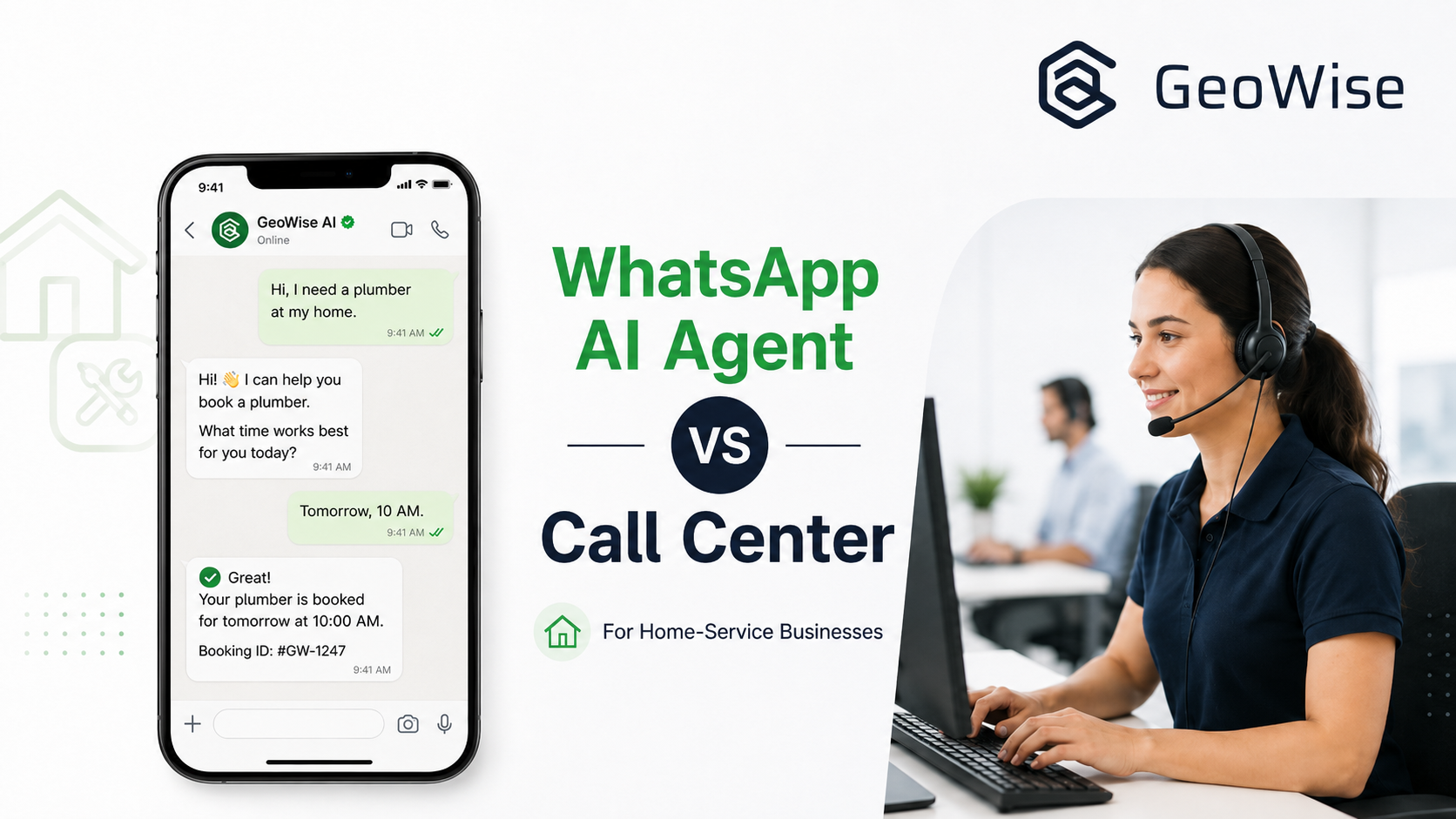
WhatsApp AI Agent or Call Center? Choosing for a Home-Service Business
Ditch traditional call centers for a WhatsApp AI agent to boost response speed and scalability in your home-service business