
AC Maintenance Scheduling Software in Saudi Arabia: Built for the July Rush
Picture a Tuesday morning in Riyadh in mid July. It's on its way to 43°C, roughly 109°F, which Weather Spark lists as the average daily high for the month. Your WhatsApp has been buzzing since dawn: a dead unit in Al-Suwaidi, a "today please" tune-up in Al-Yasmin, three leaking office units in Sulaimaniyah. And you're standing in the middle of it, assigning three technicians from memory or a spreadsheet. That's the moment most owners go looking for AC maintenance scheduling software in Saudi Arabia, and most of what they find was built for a different market entirely.
I'll say the quiet part out loud: your July problem isn't demand. It's that every hour a salaried tech spends crossing Riyadh between badly sequenced jobs is an hour you paid for that earned nothing.
Why generic HVAC schedulers fall short here
Search this topic and you'll find solid US-built tools, Jobber, Housecall Pro, Zenbooker and friends. They schedule fine. But almost none of them treat WhatsApp as the primary booking channel, and in Saudi Arabia that's where your customers actually are. A missed WhatsApp at 11pm in July is usually a job your competitor wakes up to. The second gap is bigger: most schedulers book whatever slot is free, then leave a human to untangle the map afterwards. The routing pain gets treated as dispatch's problem instead of being prevented at booking time. We've written more on that idea in our guide to zone-based scheduling for home services.
The drive-time math, three techs in Riyadh
Here's a worked example, all assumptions on the table so you can rerun it with your own numbers. Say you run 3 techs, each doing 6 visits a day at 45 minutes per visit, inside an 8-hour working day.
Scattered booking (first free slot wins): Riyadh sprawls, and summer traffic is real. Assume 35 minutes average between consecutive jobs. That's 5 transitions × 35 = 175 minutes of driving per tech per day. Across the team: 525 minutes, nearly 9 paid hours of windshield time daily.
Location-aware booking (each tech's day clusters into nearby districts): assume 12 minutes average between jobs. That's 5 × 12 = 60 minutes per tech. Savings: 115 minutes per tech, 345 minutes across the team, every single day.
Now convert it. A clustered extra job costs 45 minutes of work plus 12 of driving, 57 minutes total. 115 ÷ 57 = 2 extra jobs per tech per day, so 6 extra jobs for the team. At a hypothetical 180 SAR average ticket that's 1,080 SAR a day, about 28,000 SAR a month over 26 working days, before you count fuel. Personal admission: the first time I ran this math I didn't trust the result and redid it three times. Drive time hides because it never shows up on any invoice.
Want to see what your own team's numbers look like? Set up GeoWise and run it live.
What location-aware booking actually changes
GeoWise makes the dispatcher's decision at the moment of booking. When a customer in Al-Naseem asks for a slot on WhatsApp, the AI doesn't offer every open time, it offers the times when a tech is already going to be near Al-Naseem. Same logic on the web widget and the phone AI, one brain across all three channels, with a live map and zone control in the admin portal. For the broader landscape, see our overview of field service scheduling software in Saudi Arabia, or how location-based scheduling works under the hood.
A quick word on triage
Peak season isn't just volume, it's mix. A no-cooling emergency at 43°C is not the same booking as an annual service. Reserve emergency slots inside each zone rather than one city-wide buffer, so urgent calls get a fast ETA without shredding the routes you've built. Your annual-contract customers can absorb a day's flexibility; the family with a dead unit cannot.
FAQ
How is this different from Jobber or Housecall Pro? Those are strong platforms for US-style operations. GeoWise differs in two ways: WhatsApp-native booking with Arabic AI, and drive-time-aware slot offering at booking time instead of route cleanup after. If your leads come through WhatsApp and your city is Riyadh, not Richmond, that's the fit question.
Does it handle Arabic WhatsApp conversations? Yes. The booking AI converses naturally in Arabic and English, collects location and problem type, books, confirms, and reminds, and you can train and test it from the admin portal.
Is it worth it for a 2 or 3 tech operation? Smaller teams feel wasted hours more, not less. One tech out of three is a third of your capacity, and the math above scales down directly.
How long does setup take? Realistically two to three days: draw your zones, load services and prices, connect WhatsApp. The hardest part is deciding your zone boundaries, and that's worth the sitting.
Can it prioritize emergencies during the summer rush? Yes, you can hold urgent slots per zone so emergency jobs get fast response without breaking the rest of the day's routing.
Closing
July doesn't forgive slow replies or wasted kilometres. The companies that grow through a Saudi summer are the ones whose booking system thinks about the map before it opens the calendar. Get GeoWise running before the next heatwave lands.
Related Articles
Managing Seasonal Demand Peaks in a Service Business: Surviving the Gulf Summer Without Adding Hours
The Gulf summer peak is predictable, not a surprise. The real constraint is not technician hours, it is drive time between jobs and the enquiries nobody answered while everyone was on site.
The After-Hours Problem: Why Home-Service Enquiries Go Cold Overnight in the Gulf
Most home-service enquiries in the Gulf arrive outside working hours, and half go to whoever replies first. What the silence costs, why a night shift is the wrong fix, and the five things an always-on WhatsApp agent has to get right.
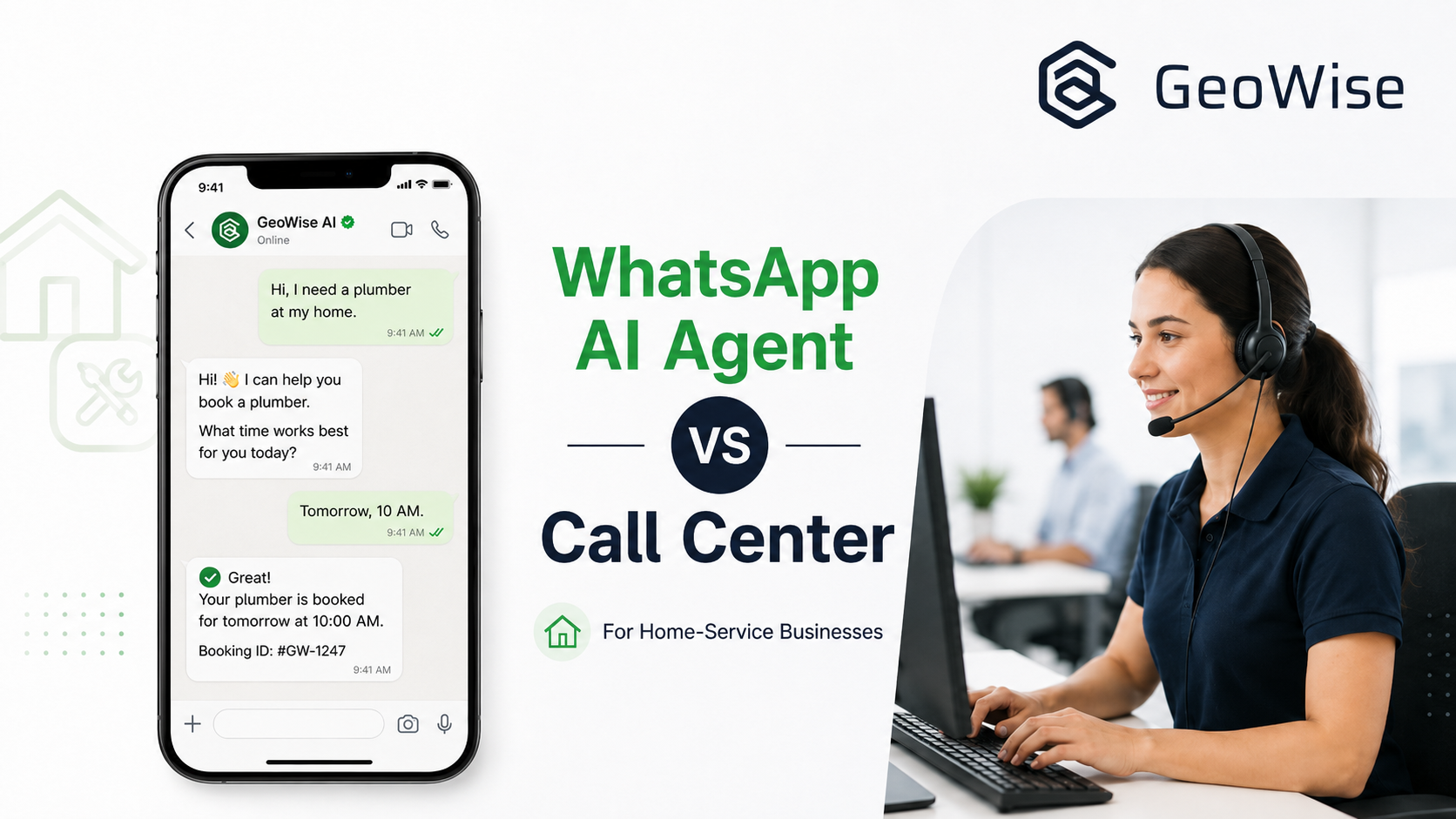
WhatsApp AI Agent or Call Center? Choosing for a Home-Service Business
Ditch traditional call centers for a WhatsApp AI agent to boost response speed and scalability in your home-service business