
Managing Seasonal Demand Peaks in a Service Business: Surviving the Gulf Summer Without Adding Hours
Every year it plays out the same way. From the middle of May through to the end of August, the phone does not stop. An AC unit fails in a villa. A family wants a deep clean before travelling. A tenant moves out and needs a handover clean before the contract closes. Pest control calls climb because the heat brings everything indoors. And most operators respond the only way they know how: they stretch the day. The crew starts at seven in the morning and finishes after dark, and by the end of the month the effort does not show up in the numbers the way it should.
Here is the part most owners never quite name out loud. The summer peak is not an emergency. It is a season, and it arrives on roughly the same dates every year. The problem during the peak is rarely a shortage of hands. It is how the day is arranged.
The peak is on the calendar already
Spend half an hour with your booking sheet and your WhatsApp history from the last two summers and the pattern is obvious. The first serious heat wave produces AC callouts. The weeks before Hajj and the holiday travel season produce deep cleans and pre-travel disinfection. Residential contract renewals in summer produce move-out cleans for villas and apartments. The back-to-school stretch produces a second wave in August.
None of that is a surprise. If you know a specific two-week block will bring double the volume, you can plan around it: spread staff leave differently, stock the parts that always run out, and most importantly, change how enquiries are received and scheduled before the wave arrives. Companies that burn out in summer are usually not the ones who failed to predict the peak. They are the ones who kept scheduling exactly the way they did in March.
Why just adding more staff does not fix it
The reflex is to hire two temporary technicians. Do the arithmetic on paper first, because the return is usually much smaller than expected. The binding constraint is not technician hours. It is travel time between jobs.
Take a simple hypothetical. A technician has eight working hours. The service visit itself takes about an hour. Schedule three visits across districts on opposite sides of Riyadh and each transfer can eat forty-five minutes to an hour in summer traffic, before you count parking, gate access and the call to get someone to open up. Result: three hours of billable work and three hours behind the wheel.
Same technician, same eight hours, but every visit sits inside one compound or two neighbouring districts. Transfers drop to ten minutes. Result: five completed visits and time left at the end of the day. You added zero headcount and materially increased capacity.
The difference is not effort, it is the map. Drop new hires into a scattered schedule and you buy the same inefficiency twice, at a higher payroll. Tightening the geography is the cheapest capacity you will ever add, and we go deeper into the mechanics in location-based scheduling for home services.
The loss that never shows up in a report
During a peak, field work absorbs all the attention. The supervisor is driving. The owner is on site with an important client. Whoever handles the phone is mid-call with ten unread WhatsApp messages stacking up behind them.
That is where the quiet loss happens. A customer messages at ten in the morning and gets a reply at four in the afternoon. In those six hours they have already contacted three other companies, and whichever one answered first with a clear time slot has the job. You did not lose on price or on quality. You lost because someone else replied sooner.
What makes this dangerous is that it is invisible. Completed jobs show up. Invoices show up. The enquiry that never converted disappears into a long chat thread nobody scrolled back to. And during a peak, enquiry volume rises at exactly the moment your team's ability to respond falls. That is the worst possible intersection for a service business.
Five levers you can pull this week
One: split the city across the days. Instead of accepting any district on any day, assign each area a fixed day or half day. North on Sunday and Tuesday, east on Monday and Wednesday. When a customer calls from a given district, you already know when a crew will be nearby.
Two: quote a real time window. Sometime Tuesday is not an appointment, it is an open promise that generates follow-up calls and wastes office time. Tuesday between ten and twelve is something a customer can plan around. It cuts chase calls and cuts failed visits where nobody is home.
Three: batch same-street jobs. If you already have a visit booked in a compound with twenty villas, that is an opening. A quick note to neighbours or to past customers in the same area fills the day with visits whose travel cost is close to zero.
Four: protect a daily buffer. In summer, a dead AC unit is the most urgent and often the most valuable job on the board. If your day is booked to one hundred percent, every emergency breaks the schedule and makes you late for everyone else. Hold one or two slots open daily. If nothing urgent comes in, fill them with deferred maintenance.
Five: stop making anyone choose between driving and replying. This is what ties the rest together. Tight scheduling means nothing if the enquiry sat unanswered for hours. An automated agent can handle first response immediately, ask the basics (district, service type, preferred time) and place the booking into the right slot based on where the customer is and where your crew already will be. GeoWise works on the enquiries you already receive: it answers them, qualifies them, and turns them into scheduled appointments instead of leaving them queued in an inbox. You can see how the approach works on why GeoWise.
A short checklist for this week
- Pull the last two summers of bookings and mark the actual peak weeks on this year's calendar.
- Count average daily jobs per technician this week. Compare your highest performer to your lowest and ask whether the gap is skill or distance.
- Draw a simple map: every district you serve, and which weekday it belongs to.
- Change your confirmation wording from an open day to a two-hour window.
- Scroll back through two weeks of WhatsApp threads and count the enquiries that never became bookings. That is your real leak.
- Fix one or two emergency slots per day and defend them.
- Put something in place so first response does not depend on a free pair of hands.
The peak arrives whether you prepared for it or not. The difference between a company that ends summer exhausted and one that ends it stronger is not hours worked. It is how the day is laid out and how fast the first reply goes out. If you run a cleaning operation specifically, there is more on structuring the work in cleaning company software.
Related Articles
The After-Hours Problem: Why Home-Service Enquiries Go Cold Overnight in the Gulf
Most home-service enquiries in the Gulf arrive outside working hours, and half go to whoever replies first. What the silence costs, why a night shift is the wrong fix, and the five things an always-on WhatsApp agent has to get right.
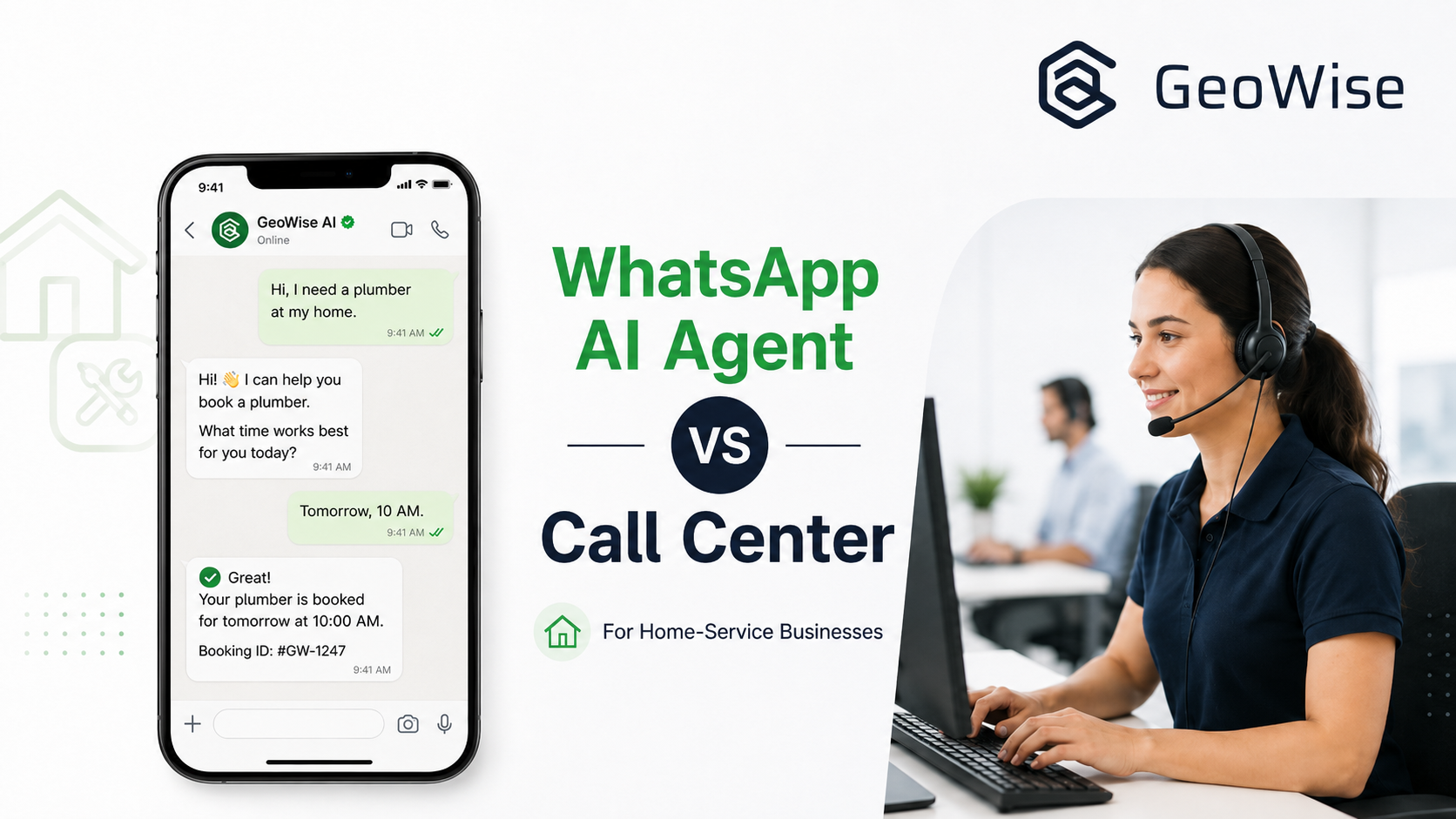
WhatsApp AI Agent or Call Center? Choosing for a Home-Service Business
Ditch traditional call centers for a WhatsApp AI agent to boost response speed and scalability in your home-service business
AC Maintenance Scheduling Software in Saudi Arabia: Built for the July Rush
July is brutal for AC companies in Saudi. See the drive-time math for a 3-tech team in Riyadh and how location-aware booking adds jobs per day.