
The After-Hours Problem: Why Home-Service Enquiries Go Cold Overnight in the Gulf
Most home-service businesses in the Gulf lose revenue at a predictable time of day: after the office closes. A customer in Riyadh decides at 21:40 that the villa needs a deep clean before the weekend. She messages three companies on WhatsApp. Two of them reply the next morning. One replies in eleven seconds. By the time the other two open their phones, the job is already booked.
Nobody logs that as a lost sale. There is no missed call, no abandoned cart, no complaint. The enquiry simply never becomes a conversation.
The enquiry does not wait until morning
Home services are bought under time pressure. A blocked drain, an air conditioner failing in August, a move-out clean before handover: the customer needs an answer now, and WhatsApp is where they ask for it. Across the GCC, that first message rarely arrives between 9am and 5pm. It arrives after work, after dinner, on a Friday, or during the hour before the weekend starts.
Which means the busiest part of your enquiry day lands squarely in the part of your day when nobody is watching the phone.
What the silence actually costs
The arithmetic is unforgiving. If ten enquiries a week arrive outside working hours, and half of them go to whoever answers first, you are handing five opportunities a week to a competitor who is not better than you. They are simply awake.
Worse, these are not cold leads. Somebody who messages a cleaning company at 22:00 has already decided to buy. They are choosing a supplier, not considering the category. That is the most valuable enquiry you will get all week, and it is the one most likely to go unanswered.
Why a night shift is the wrong fix
The obvious answer is to pay someone to watch the inbox in the evening. In practice this rarely survives contact with reality. Volume outside working hours is real but uneven, so most of the shift is spent waiting. Weekend and holiday cover is the expensive part. And a tired human answering at 23:00 still needs to check the schedule, the service area and the team roster before quoting a time, which is exactly the work that slows the reply down.
The problem is not staffing. It is that a booking decision needs four pieces of information at once: what the customer wants, where they are, who covers that area, and when that team is free. A person has to look all four up. Software already knows them.
What an always-on agent has to get right
Answering fast is necessary but not sufficient. An automated reply that says "thank you, our team will contact you shortly" is only a politer version of silence. To actually win the booking, the reply has to do five things.
- Answer in the customer's language. A customer writing in Gulf Arabic should not receive an English form response, and vice versa.
- Confirm the service and the location. Not a menu of options, a short question that gets to the address.
- Know who covers that district and when. This is where most automations fall over. Travel time and service zones decide whether a slot is real or imaginary. See how location-based scheduling handles that.
- Offer real time slots. Two or three specific windows the customer can accept, not a promise of a callback.
- Hand over cleanly. When a question falls outside what it can answer, the conversation should pass to a human with the context attached, not restart from zero in the morning.
Point enquiries at the number that answers
There is a step that is easy to skip and it undoes everything else. Once a number answers automatically, that number has to be the one your customers actually message.
In practice this means checking three places: the WhatsApp number on your paid ads, the link in your Instagram bio, and the phone number on your Google Business Profile. Businesses routinely automate one number and keep advertising another, then conclude that automation does not work in their market. The AI answered every message it received. It simply received none.
A short checklist
- Look at the timestamps on your last fifty WhatsApp enquiries. Count how many arrived outside working hours.
- Of those, check how many got a reply within five minutes.
- Send a test message to your own company number from a phone that is not connected to it. Time the reply.
- Confirm that the number answering is the number on your ads, your Instagram bio and your Google listing.
Most operators who run this exercise are surprised twice: first by how much of their demand arrives at night, and second by how long the average reply takes. Both numbers are fixable without hiring anyone.
If you want to see how this works for a specific trade, the cleaning company software overview walks through a full enquiry to booking flow, and why GeoWise covers what the platform does and, just as importantly, what it does not.
Related Articles
Managing Seasonal Demand Peaks in a Service Business: Surviving the Gulf Summer Without Adding Hours
The Gulf summer peak is predictable, not a surprise. The real constraint is not technician hours, it is drive time between jobs and the enquiries nobody answered while everyone was on site.
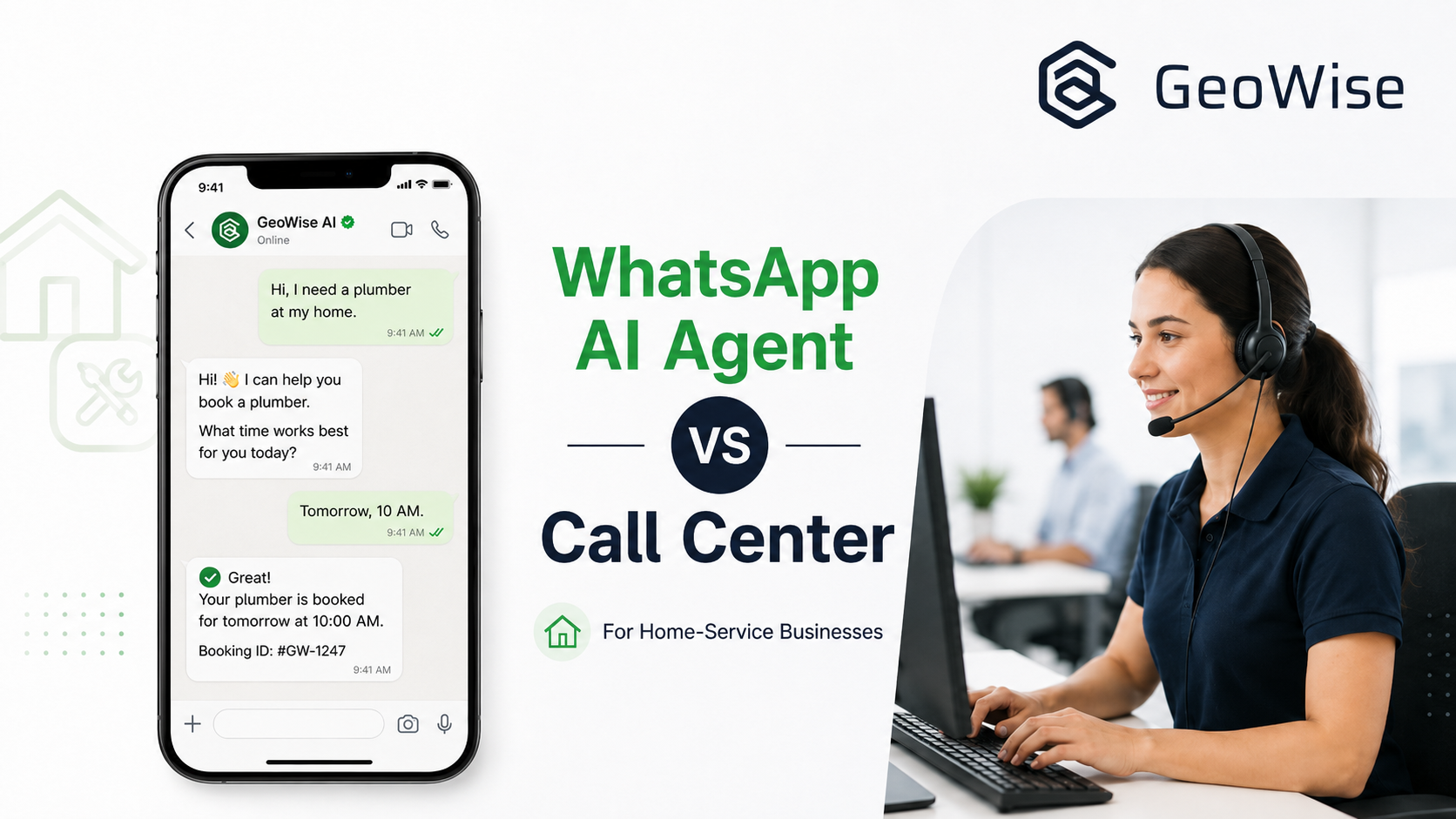
WhatsApp AI Agent or Call Center? Choosing for a Home-Service Business
Ditch traditional call centers for a WhatsApp AI agent to boost response speed and scalability in your home-service business
AC Maintenance Scheduling Software in Saudi Arabia: Built for the July Rush
July is brutal for AC companies in Saudi. See the drive-time math for a 3-tech team in Riyadh and how location-aware booking adds jobs per day.